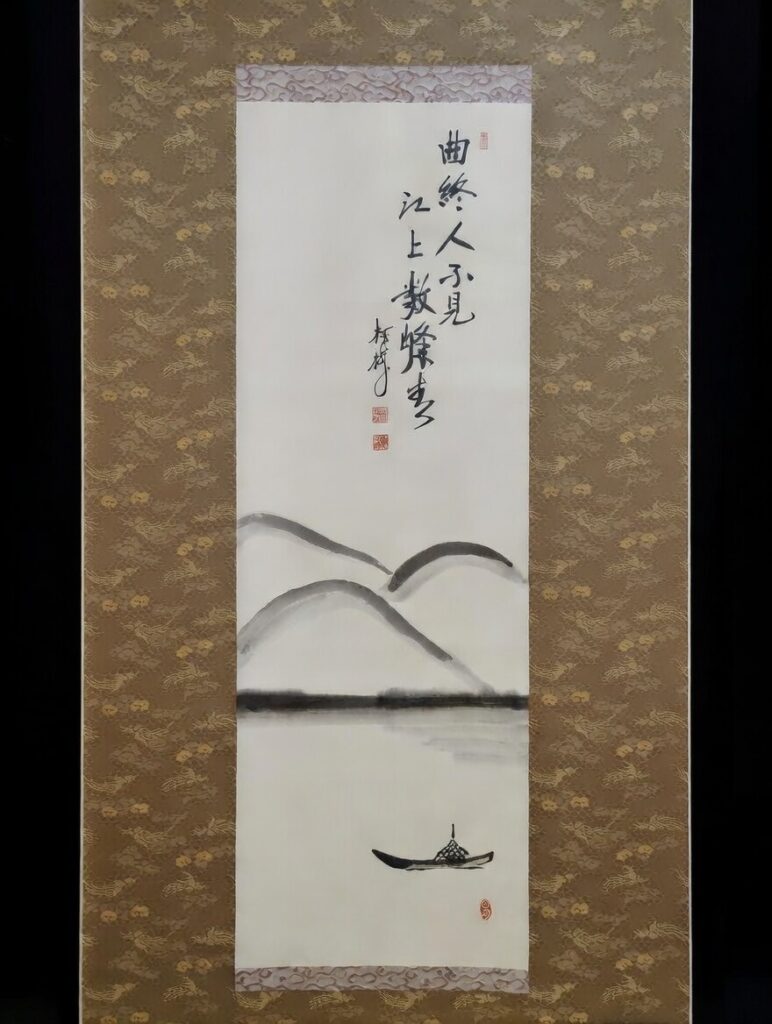
曲終人不見,江上數峰青
“曲終人不見” (the song ends, the person is nowhere to be seen)
“江上数峰青” (over the river, a few peaks of green)
This beautiful line by the Tang poet Qian Qi (錢起) comes from a Provincial Examination Poem on the Xiang River Spirit Playing the Se (Zither), written for the imperial civil-service exam around 751 CE, to demonstrate poetic skill. But it can be read in various ways.
Here is the full poem for context:
善鼓雲和瑟,常聞帝子靈。
馮夷空自舞,楚客不堪聽。
苦調淒金石,清音入杳冥。
蒼梧來怨慕,白芷動芳馨。
流水傳瀟浦,悲風過洞庭。
曲終人不見,江上數峰青。
The poem imagines the mythical Xiang River goddess playing a divine zither. Her music is so beautiful and mournful that even river gods dance and ancient emperors grieve1. Yet when the music stops, the goddess herself has vanished, leaving only the serene blue mountains reflected on the river.
The song is Khandha, the flow of the five aggregates2. The song ends, signifying the inevitable cessation of all conditioned phenomena. Anicca, the music of life, the noise of the self, falls silent.
The person (in this case, the goddess) is also a designation for the Khanda; the person is a concept arising from the causal process, which, when it ends, is “nowhere to be seen” (Anattā).
When all Kilesa are calmed, what is left is Nibbāna. On the other side of the “river” of Saṃsāra are the silent, cool “peaks of green” of the Asaṅkhata3 Dhamma, untouched by the floods of passion and ignorance.
The song (Saṅkhāra) fades, the ego (Attā) is absent, and what remains is the Asaṅkhata Dhamma: quiet, stable, and utterly at peace, like the green peaks rising above the ephemeral mist of the world.
- “苍梧” (Cāngwú) in the seventh line: This is the name of a mountain (also known as Jiuyi) in Hunan province. According to legend, this is the place where Emperor Shun died and was buried. The line “苍梧来怨慕” (From Cangwu comes longing and sorrow) describes the spirit of the deceased Emperor Shun, buried at Cangwu, being moved to longing and sorrow by the mournful zither music of his wives (two wives became gods together, but poetically merged into one representative figure, the Xiang River goddess) ↩︎
- form, feeling, perception, mental formations, consciousness ↩︎
- Unconditioned ↩︎